|
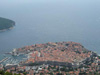 There are several theories on the establishment of Dubrovnik (Latin Ragusa), a widely accepted is that the city is founded in the 7th century, when the Latins from the city Epidaurus (today's Cavtat), sheltered before the invasion of Avars and Slavs in the rock Laus, which means rock. There are several theories on the establishment of Dubrovnik (Latin Ragusa), a widely accepted is that the city is founded in the 7th century, when the Latins from the city Epidaurus (today's Cavtat), sheltered before the invasion of Avars and Slavs in the rock Laus, which means rock.
Later, Slavs built a village on the southern slopes of Mount Srđ, on the mainland across the rocks and called it Dubrava, which means noise dub (oak). The strait between the island and the mainland became shallow between 9th and 11th century so in the end of the 11th century, it was banked. At the point where the island is connected with the mainland, there are the broadest and most famous streets in Dubrovnik - Salary and Stradun. In the 12th century, both places are completely connected, protected itself with a unique defense system of the city wall, which in the 13th century surround the northern suburb, it was carried out regulation of streets, and Dubrovnik is integrated into its present range. According to other theories and ancient inscriptions, Dubrovnik was founded and before the third century, as a small village on the island of Laus.
Today there are new concerns about the emergence of Dubrovnik, because they both mentioned the theory proved wrong. During the renovation of the Cathedral, deep under the foundation of today's buildings have been found remains of two former churches, one of which was known before, and others even older, dating from the 5th century. In addition to change the theory is the discovery of the town walls, dating back to the same period. When probing main street, it was established the fact that the islet Laus never existed, because Stradun not a dyke than a natural sandy beach, which stretched between the hills of "Srđ" and rocky areas (referred Lausa). New insights, as well as the discovery of Greek coins and pottery under low mule in the port, confirm the thesis of some historians, the beginnings go back long before the 7th century, the time of the ancient Greeks. The Dr. Ničetić setting, which he argues is the inevitable existence of the ancient port of Budva and the island is further provided for the authenticity of the thesis about the origin of the settlement still in Greek times.
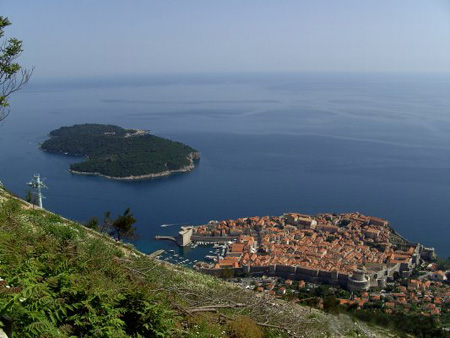
Dubrovnik was originally a part of the Dalmatian theme and it acknowledged the rule of Byzantium. For the first time, as mentioned in the documents in 850 and around 992, Dubrovnik Archbishopric was established. Then the church becomes independent from Split. Since 1205, the Venetian Republic, using the Crusade, rules with the government of Dubrovnik, which lasts until the 1358. At the time of Venetian rule, Dubrovnik raised three rebellions, but they could not get rid of the Venetian nobility.
While acknowledging the Venetian authorities, Dubrovnik managed to preserve its autonomy, because it chose Small and Great Council, Senate and other bodies of the city government. Commune gained statute in 1272. In Dubrovnik was very early developed trade, especially with the background and primarily with Bosnia at the time of Ban Kulin.
The population is divided into rich nobility: patricians (nobiles cives), city Regiment - commoners, usually on matters of merchants and sea captains, and the clerk, and the serfs, the peasants who work for the nobility - the land deal. Patricia was trying to shut down within them, but the result is withering away from noble families. They had to give out and enter into marriage with the population.
During the rise of Raska he successfully defended himself against her attacks. In the 13th century, the power of Dubrovnik was increased in the broader metropolitan area and surrounding territory. So Lastovo voluntarily joined the Dubrovnik, and for 1333 year the part of the Republic of Dubrovnik has been Peljesac with Ston. Serbian Emperor Dusan in Dubrovnik relinquishes control of the cape Ston (Peljesac) a fee of 500 perpera, payment of taxes. In 1345, Mljet was a part of Dubrovnik.
Ston had great strategic importance for the Dubrovnik, since that he could control navigation around the mouth of the Neretva River in the Mljet channel. The area from the Ston to Bay Dubrovnik ensured when in the 15th century from Bosnia bought Konavle. Then they set the boundaries of which the end of the 15 century recognizes all Dubrovnik neighbors.
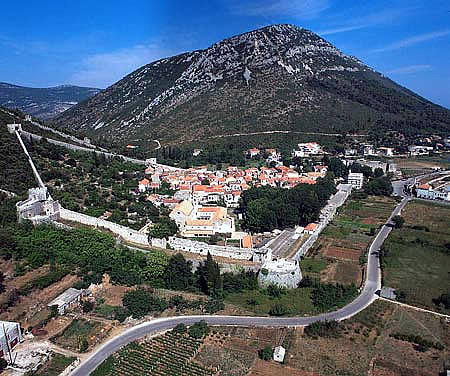
Dubrovnik has signed numerous international agreements with the Italian cities, especially with Pisa and neighbors in the hinterland of Bosnia and Serbia, providing most dominant and privileged position of Dubrovnik merchants.
Zadar pace gets rid of Venetian domination since 1358, because Venice had to renounce his possessions on the east coast of the Adriatic. Since that year, Dubrovnik has recognized the supremacy of Hungary-Croatian rulers, who did not mess with the interior, the administrative, commercial and maritime affairs of Dubrovnik, which resulted in complete independence of the aristocratic Republic. It was formerly COMMUNITAS RAGUSINA (Municipality of Dubrovnik) grown in REPUBLICA RAGUSINA (Republic of Dubrovnik). Since that time Dubrovnik increasingly builds their autonomy and independence. Elect their prince of Dubrovnik, and after the death of Louis I., in 1380 it develops into an independent and recognized Republic.
|




 Dubrovnik's History